






Employee stories


What our employees say
BMA has more than 650 employees worldwide. Because of our international business processes, it takes people in a variety of jobs to get all the work done. We have employees in production, for instance (plant) mechanics, machinists or electricians, and also in commercial and technical areas such as IT, marketing, sales, project management, logistics, controlling and accounting. In fact, BMA also provides training for many occupations.
This section of our website features interviews with employees from a wide range of areas – who tell you honestly and in their own words what it is really like to work for BMA. If you are considering a future career at BMA, why not take a look at them!
Interviews
Interview Robert Bessel
Looking at the world from a hot air balloon
BMA employee Robert Bessel talks about his passion
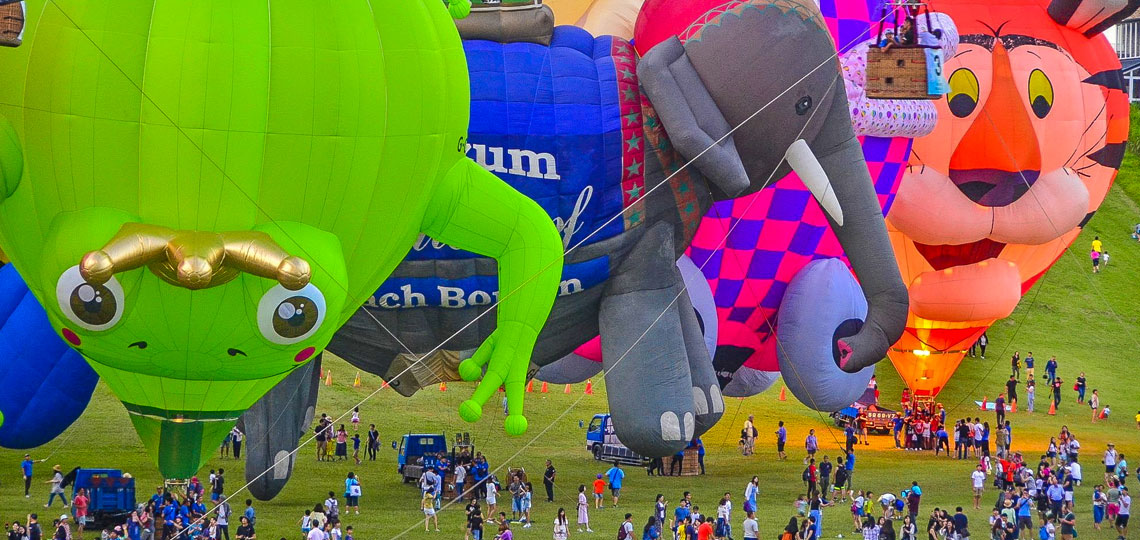
Floating through the air – who hasn’t dreamed about it… Robert Bessel, Senior Manager Health, Safety & Environment at BMA in Braunschweig since May 2018, has made this dream come true. He has turned his hobby, ballooning, into a small enterprise.
Mr Bessel, when did you decide to become a balloonist?
In the early nineties. I saw a balloon take off and found it fascinating. Through a friend of mine, whose father then worked for the German Federal Aviation Office, I quickly found my way into the ballooning world. At the age of 25, I got my pilot’s licence.
You even set up your own company, AIR-lebnisse, a name that roughly translates into “air experiences”. How long ago was that?
After completing 50 flights, I was allowed to take passengers on board. I initially worked as a freelancer for a number of German and Dutch companies, flying balloons in Europe. They were mostly special-shape balloons, which do not have the typical upside-down drop shape but look like characters or objects, such as a mouse, a penguin, a bottle of coke, or even a phone box. In 2011, I set up my own balloon company, which now owns two hot air balloons.
Do you work on your own?
You could say it’s a small family business. My oldest son is currently training to get his pilot’s licence, and my wife manages the office. We have two additional pilots and twelve so-called retrieve crew, who follow the balloon by car and pack up all the equipment after landing. We all do this alongside our other work, as a hobby.
Can anyone become a balloon pilot?
You have to be at least 16 years old and pass a medical examination, so you need to be fairly fit.
How long does training take and how much does it cost?
You have to complete several training rides at temperatures above 20 °C and below freezing, and pass a written examination, so it takes at least half a year. And it costs between 5,000 and 10,000 euros.
Plus, you have to pay for the balloons…
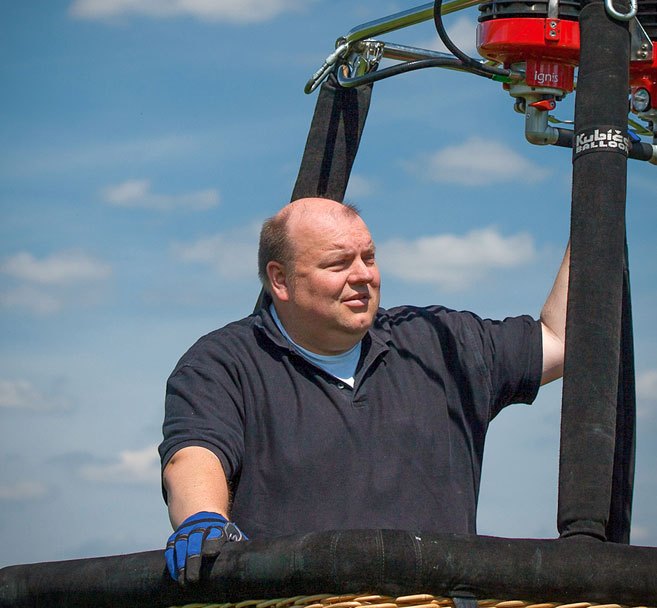
That’s right. Balloon equipment such as mine will cost you around 65,000 euros and let you carry up to five passengers. Then you need the vehicle and trailer, the inflation equipment, and other things.
How important is the weather for launching a balloon?
It’s vital. You need fair weather with only little wind, and there mustn’t be any danger of precipitation. Weather conditions have changed a lot. Today, we can do about 50 rides in a good year. Ten years ago, that figure was about 100.
How far can you travel in a balloon?
Five to ten kilometres is normal. But there are performance flights, where we have as many gas bottles on board as we need to keep going the whole day. During normal passenger rides, we travel at a speed of up to 10 knots, which is equivalent to a little more than 18 km/h.
Do you ever get situations where you can’t take off?
Sometimes we’ve unpacked everything and are ready to go, but then the weather suddenly makes a take-off impossible. That can happen, for instance, when weather fronts move more quickly than forecast.
Have you ever had passengers fly with you even though they’re afraid of heights?
Yes, that happened to me once. But after a few minutes, I managed to get the lady to look down from the basket. She has since taken several balloon rides and enjoyed them a lot. In her experience, her fear does not manifest itself when she’s in a balloon. You suffer from a fear of heights when you’re on the ground, but not in the air.
What has been your most beautiful experience during a balloon ride?
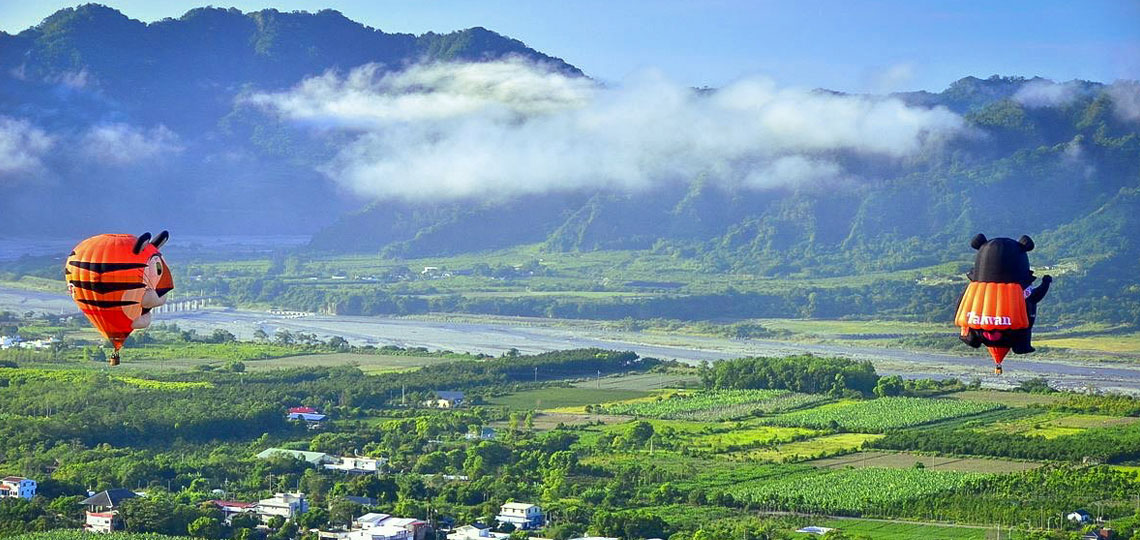
Every balloon ride is beautiful in itself. Last year, I went to Taiwan to take part in one of the world’s largest ballooning events. It lasted more than ten weeks, and I was there for two of them. Just from a scenic point of view, it was a tremendous experience. I flew across pineapple, banana and mango plantations and experienced the strong scent of all this fruit, even up in the air.
And what has been your funniest experience?
Once, during landing, I had almost reached the ground when the burner started up again. We had to thank a passenger who wanted to “help” for that… The retrieve crew still chuckles today when they remember my face as we suddenly moved upwards again and had to find a new landing spot.
Do you always know exactly where you will end up landing the balloon?
No, only roughly. In ballooning, the journey is your goal. Every time, you will have a different speed and go off in a different direction. That gives you millions of landing options. Taking off from the same place, I’ve never landed in the same spot twice. Every flight is unique.
What advice would you give to people planning their first balloon ride?
Just do it – you’ll be looking at the world differently afterwards.
Thank you for these fascinating insights! Good luck for future flights and with your passengers! Actually, what do you say to a balloonist as
they take off?
Gentle breezes and soft landings!
Interview Caroline Ulsamer
Two kisses left and right
Caroline Ulsamer is one of Germany’s best formation dancers
It is by now a good tradition: every year’s BMA Info introduces a member of the BMA team who has an unusual hobby. For this issue, we have spoken to Caroline Ulsamer, who joined Human Resources at our Braunschweig site as a working student in April 2019. Caroline’s great passion is dancing.
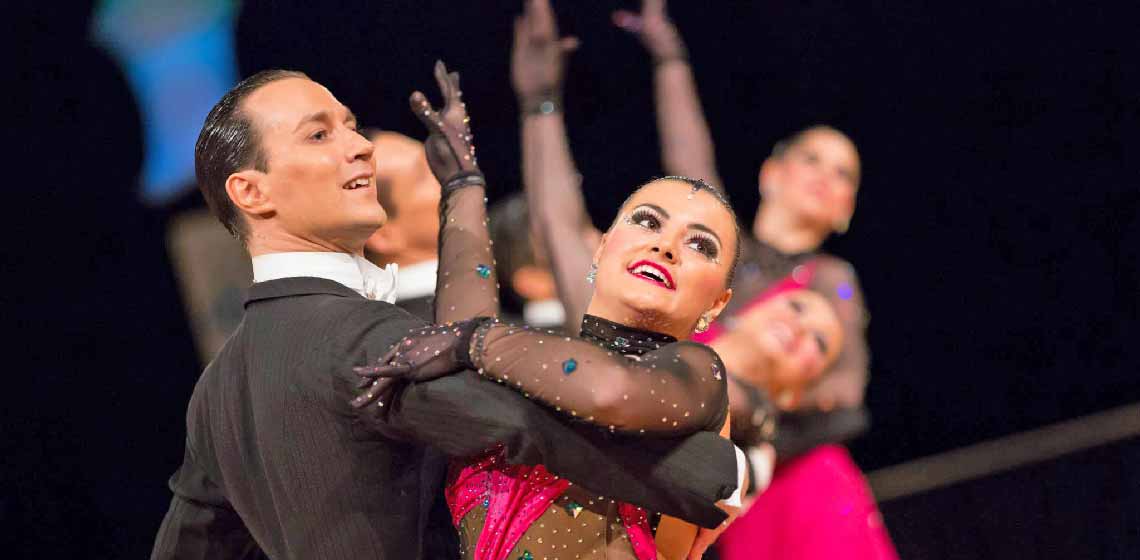
Braunschweiger TSC · Final | 2019 World Formation STD Moscow
Can you remember your very first dance lesson?
Yes, that was at dance school, with a class mate. I also played volleyball at the time, and I sang in a choir. It was quite difficult to do both, sports and singing. And then dancing as well…
When did you start with formation dancing?
I’ll never forget watching A formation dancing – they are the top dancers – in the German league: it was in the huge Volkswagen event hall and I was 15 years old. At the time, I said to my mum: “I want to be able to dance like that!” Just a few weeks later, I took part in a dance casting at the BTSC, without much preparation. I had a start number stuck to my back, and off I went.
How did it go?
After the audition, I got really positive feedback and a lot of praise. Along the lines of: “That was very impressive!” And not much later, I was in the middle of training for the B formation. Two years later, my dream became reality: I was on the dance floor for the last major competition of the season.
How many competitions are there in a year?
Now I dance in the A formation in the first German league, and our season runs from January to March. There are five competitions during that period. On the day of a competition, our formation has to present its choreography twice. Our performance is rated by a panel of seven judges, or even twelve in major championships.
The ballroom dresses are absolute eye-catchers. Do you have to buy them yourselves?
No, our club provides the dresses and suits. We wear each dress for as long as we do a specific choreography, that’s normally three years. But all dancers have to pay for their own shoes.
In competitions, all women have the same hair colour and style. Do you have a make-up artist for that?
No, we do it ourselves. To make sure we all look the same, we do each other’s hair, usually the night before a dance competition. We finalise it the next morning, before the competition starts. On the morning of the German championship, we got up at 4 a.m. to do our hair. We spray black hairspray on our hair, clip a hair piece on the plait, and finish off with rhinestone hair accessories. It can take four to five hours for all women to have their hair styled, put on make-up and stick on lashes.
Do you have backups, as you do in football?
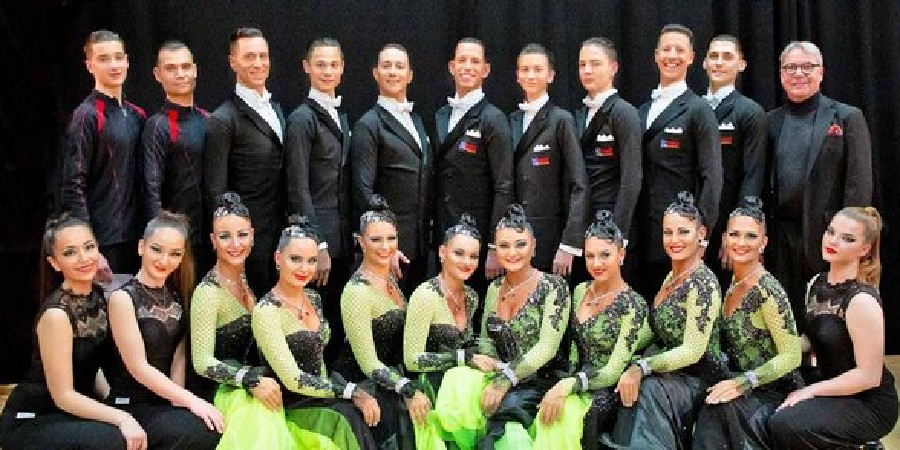
A team consists of more dancers than the eight regular couples. It would be lost without dancers that can step in in unexpected situations. That’s why there is a ninth couple next to the dance floor. The coach may decide to change the formation, because of performance-related or health problems.
To the audience, it looks as though you float across the dance floor, your movements are so light. How often do you have to train?
We train between five and seven days a week, that’s around 20 training hours overall.
Do you get paid for your sport?
No, I don’t earn any money as an amateur formation dancer. I would only be able to earn some money with dancing if I became a professional dancer as part of a couple.
Many sports clubs say they have problems recruiting young talents. Is that the same in dancesport?
Not as a rule, but it would be nice if more men were interested in this beautiful sport.
You’ve now finished school, started university, and you’ve been working at BMA since you’ve been a student. Do you think you’d keep up this intensive dancing if you had a full-time job?
Absolutely! I think it would even be easier with regular working hours than it is for a student. At university, I have one day off, but the next day, I have lectures from 8 in the morning to 6 in the evening.
Is there any special experience that has stayed with you?
After the final training session, the night before the world championship, I was told that I would dance in the championship competition. That has been my biggest success to date. The second, incredible experience was being runner-up in the German championship, right after the world championship. Those are moments that I’m sure I’ll never forget.
Do you go dancing with friends, in the evening? Or do you feel that you’ve actually had enough?
Occasionally, I do go dancing, on the night before 1 May, for instance. But my problem is this: when men find out I dance with the BTSC, it scares them off and they no longer want to dance with me.
Which standard dance is your personal favourite?
It has to be the dance that is, in my opinion, the most expressive: tango.
Your current dance partner is very young. How often do you get a new partner?
You’re right, Anton is only 16 years old. The men are generally told their position quite early before a major competition. But the women often find out much later what their position is. That’s to do with how well the individual couples dance together. Anton is my fourth dance partner.
What do dancers say for good luck before their performance?
Have fun – accompanied by a hug and usually two kisses left and right.
Interview with Sascha Sonntag
Senior Manager Field Service
What could you not live without?
Sascha Sonntag: My family, particularly my 10-year-old daughter. I started working 20 years ago. At the time, my wife and I decided that she would put her career on hold, so we could start a family. That gave me security, of course, both at work and at home.
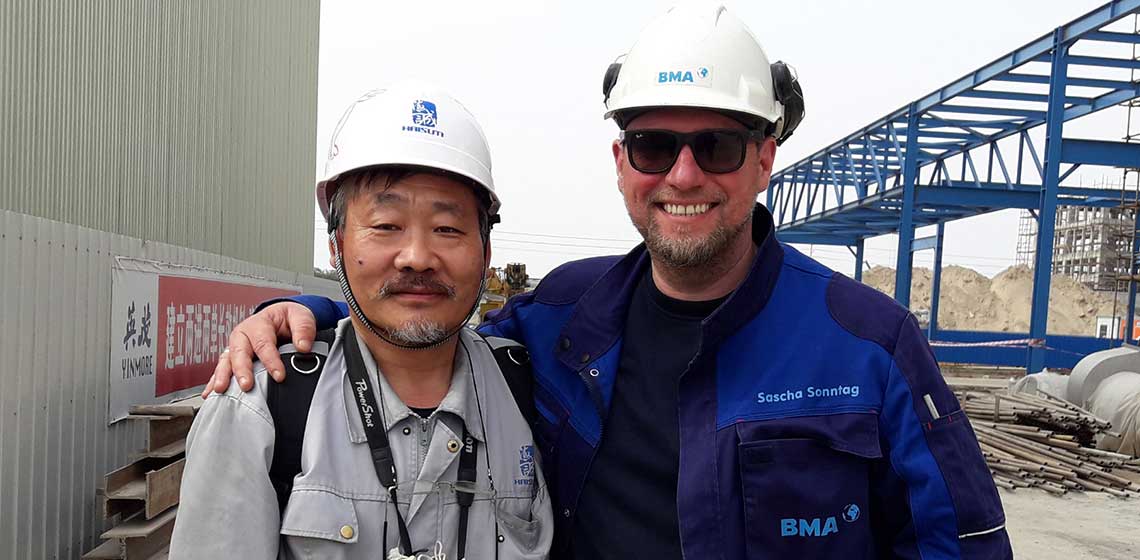
What made you choose the job you do today?
Well, you set yourself some goals in life, don’t you, and immediately after I completed my training, I had the opportunity to work on a construction site in Switzerland. I was born in East Germany before the wall came down, so Switzerland seemed a long way away to me, real freedom! Before then, I’d only ever commuted between Aschersleben, just across the former border, and Braunschweig. My next job was as a site supervisor for a company specialising in conveying systems, so I was posted abroad to a range of locations. Later, the company put us on furlough, the situation was uncertain, and, because of the financial situation, some agreements weren’t kept. A colleague told me about BMA and that he’d applied there. So I tried to find out a bit about BMA, thinking: „I’ve worked in the salt, gravel and cereal industries, so I should be able to do sugar.“ And I got the job.
Initial training was really good, and when you work on a long-term construction site, you have time to get to know the country. On site, you’re the customer’s first contact – and sometimes also an entertainer. That has helped me hone my intercultural skills – definitely a positive effect.
Through travelling, I’ve become far more open-minded, but also more grounded. Domestic and foreign policies, education, or social issues – when those topics crop up at family gatherings, I often have to bite my tongue. Problems? I have clean running water, electricity, food, and a roof over my head.
What will your next project be?
Since February 2020, I’ve been heading the Field Service Project Products Products team, and I mostly work in the office now. I’d also like to do a part-time course to qualify as a state-certified technical engineer. In my new job, I’ll be able to help my wife better with looking after our daughter. Of course I’ve been told „You’re away a lot of the time“. It’ll be a learning curve for my wife to let someone else be in charge.
What career did your parents have in mind for you?
My brother and I both went into vocational training after we finished school. That was very important to my parents, especially after the wall came down. I would’ve actually quite liked to be a radio presenter.
And you could certainly have done that, Sascha – but we’re very glad to have you at BMA. Thank you!