


Why science is of particular importance at BMA
At BMA, we continuously improve our plants and machinery, based on scientific findings from tests, which we use in product development.
Basic research into cane sugar
BMA has successfully deployed well- established plants and equipment from the beet sugar industry in the cane sugar sector. This technology transfer from beet to cane is possible for many process steps. Our research in the BMA laboratory supports practical implementation with scientific methods.
For its crystallisation equipment, BMA regularly collects specific data. In a new study, we have been looking at raising the boiling point of cane sugar molasses. This knowledge helps us reliably forecast the output results of crystallisation plants, also in cane sugar factories, and determine how they can be put to best possible use in the energy system.
The raising of the boiling point is determined by looking at boiling temperatures. To measure the boiling temperature, our laboratory relies on a special glass apparatus for use in the subatmospheric pressure range. When varying the boiling pressure, the dry substance content and molasses purity, a parameter eld is produced for the boiling point increase of cane-sugar molasses. This boiling point increase results from the correlation with the set pressure and the boiling point of water.
These data provide a reliable basis for a cane sugar factory to plan its pan boiling process and the subsequent cooling crystallisation plants.
Better syrup separation for batch centrifugals
An ingenious idea is one that is of unexpected value for practical application as well as being easy to implement. And it’s precisely this simplicity that sometimes makes us doubt an idea’s effectiveness. For syrup separation in E-type centrifugals, the question is therefore this: What is the actual bene t of the syrup separation duct?
BMA studied syrup separation in a range of operating conditions over the course of two campaigns. Our focus was on varying the amount of wash water and the point at which it is applied; the use of syrup washing; and the impact of massecuite quality.
The scientific findings from this study clearly show that syrup separation is of significant bene t to operators: either the colour in the high-green syrup is more than halved for a given amount of syrup; or almost twice the amount of high-green syrup is produced for a given syrup quality.
In the first case, the syrup entering the crystallisation process does not contain too much colour, which helps reach the desired product quality; in the second case, a higher output can be achieved during crystallisation.
E-type centrifugals already come with the new syrup separation duct.
Slurry mill: adapted to meet EU requirements
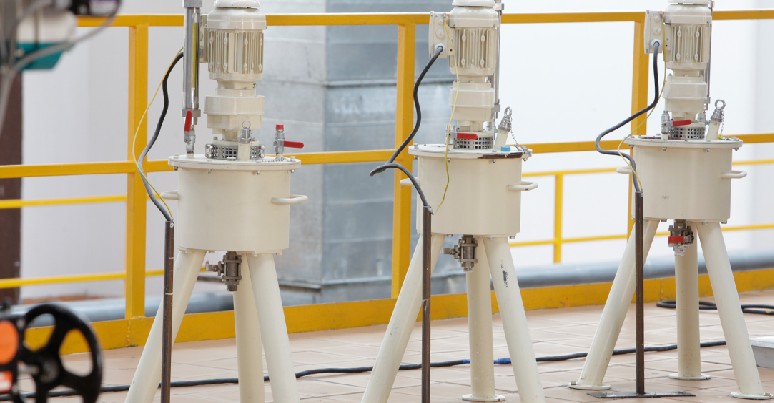
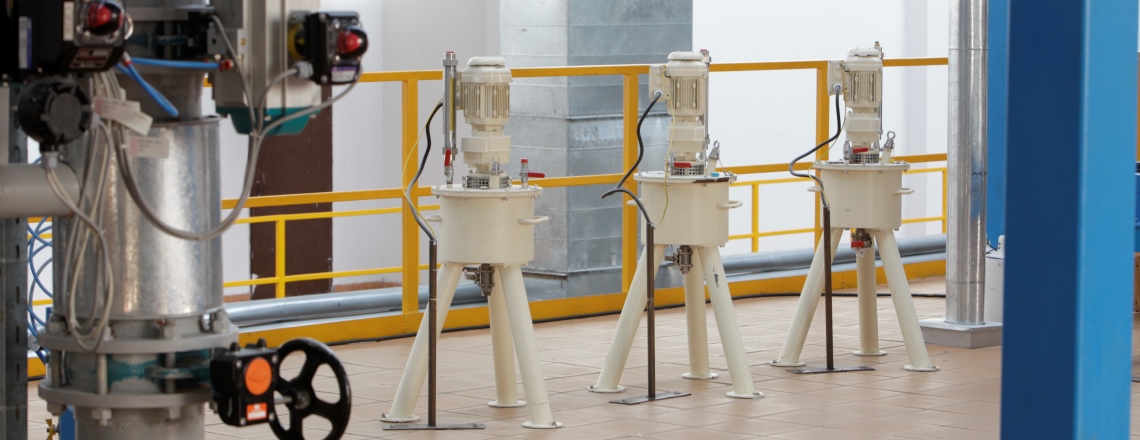
A tiny detail with a huge impact: that could be said about adapting our slurry mill to the new explosion protection regulations. To prevent the presence of isopropanol and oxygen – an explosive mixture – in the milling chamber, the mill is rinsed with nitrogen after it is loaded, and the milling chamber then closed. This ensures there is no oxygen in the mixture.
Before deploying the solution at the customer’s, we tested what impact this change would have. Much to our surprise, it affected the milling result! Crystal size distribution, shown as the CV value of the crystals in the slurry, deteriorated, rising from less than 30 to 45 percent. This slurry would only be of limited use for the seeding of a crystalliser.
In laboratory tests, we found out how to restore the previous milling result, ensuring the slurry mill could be used: by lengthening the milling time. Our finding: when the milling time is lengthened by 50 percent, a CV value of between 25 and 28 percent results, with the same average particle size of the slurry of approx. 10 μm.
From the laboratory to practical application: BMA delivers a slurry mill with a new recipe.
Related Products

E-series